
For up-to-date course syllabuses and teaching staff contact details, CLICK HERE!
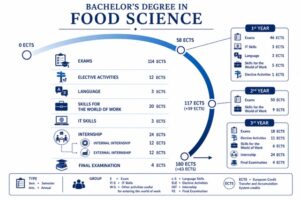
The Bachelor’s Degree in Food Science follows a single three-year study pathway, with 114 ECTS credits in taught courses, 3 ECTS credits in IT skills and 3 ECTS credits in a foreign language at B1 level. You can tailor your studies to your interests with 12 ECTS credits in elective activities. The programme also includes activities worth a total of 20 ECTS credits to help you build the skills you’ll need in the workplace, as well as an extensive practical training programme worth 24 ECTS credits. Half of this training takes place at our university (12 ECTS credits), and the other half at companies with placement agreements with our department (12 ECTS credits). You’ll complete your degree with a final assessment worth 4 ECTS credits.
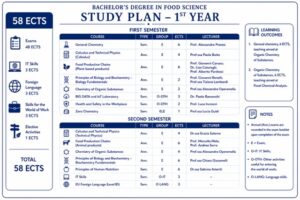
The Food Science degree programme was launched in the 2025–2026 academic year, so this is our second year of welcoming first-year students. Based on student feedback, we’ve made some changes to help the programme run more smoothly and make it easier to follow.
In your first year, some courses run throughout the academic year. Some are split into two modules, one in each semester, while others are taught across both semesters without separate modules. You’ll be able to take module exams or interim tests, but your final grade will only be officially recorded once you’ve passed all the modules or completed the full exam.
The first year mainly focuses on foundational subjects and the production of both plant-based and animal-derived foods.
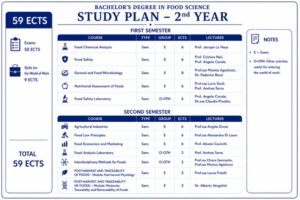
The second year of the programme will run for the first time in the 2026–2027 academic year. All taught courses last one semester, for a total of 50 ECTS credits: 26 in the first semester and 24 in the second. You’ll also take part in three activities designed to help you prepare for the workplace, worth a total of 9 ECTS credits: 4 in the first semester and 5 in the second. Throughout the second year, you’ll explore food from a range of perspectives.
You’ll find the full details below.
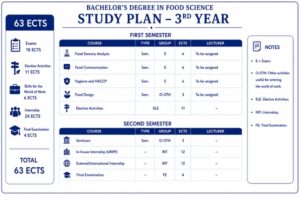
The third year of the programme will run for the first time in the 2027–2028 academic year. All taught courses will take place in the first semester, for a total of 18 ECTS credits. During this semester, you’ll also have the opportunity to tailor your studies with 11 ECTS credits in elective activities.
There will be no classes in the second semester, so you can focus on your practical training and internship (24 ECTS credits) and your final assessment (4 ECTS credits).
The periods scheduled for course exams are as follows:
September 2025, January 2026, February 2026 (until 27 February 2026 inclusive), June 2026, and July 2026.
For “students beyond the standard duration of the program”, “working students”, “parents with children under eight years of age”, “students on maternity leave”, “students enrolled in single courses”, and “students repeating the year” (Art. 23, paragraph 9 of the University Teaching Regulations), it is possible to take exams also during periods designated for classroom or laboratory teaching activities; for second-year students enrolled in Master’s Degree programs, it is possible to take course exams in the winter/spring session (March–May).
Public holidays and suspensions decided by the Academic Senate are excluded from the above-mentioned periods.
For each Degree Program and for each course unit, a minimum number of 6 exam sessions per academic year is guaranteed, excluding those reserved for working students, students beyond the standard duration of the program, parents with children under eight years of age, students on maternity leave, students enrolled in transitional single courses, and students repeating the year, which must be no fewer than 2.
The exam dates are published on the online exam registration portal.
Course Syllabi Each course offers a minimum of eight examination opportunities throughout the academic year, organized into four examination periods (exam sessions), as illustrated below.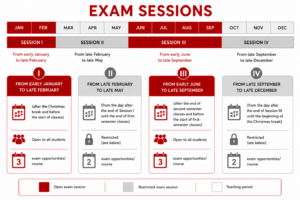
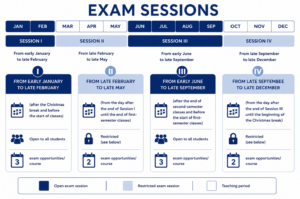 Some examination periods are reserved for specific categories of students. You may register for these sessions only if you meet at least one of the following conditions:
- You are an out-of-course student (beyond the standard duration of the degree programme);
- You are a working student;
- You are a parent of one or more children under eight years of age;
- You are on maternity leave;
- You are enrolled in single courses;
- You are enrolled as a repeating student (Article 23, paragraph 9, University Academic Regulations).
For the official exam session calendar and the dates of individual examination opportunities, please refer to the University’s online exam registration portal.
You must acquire the IT Skills (3 CFU) by successfully completing one of the following modules of the SAI@UNIPI project:
[001SA] TECHNIQUES AND TOOLS FOR DATA MANAGEMENT AND ANALYSIS – SAI@UNIPI.IT (3 CFU) [002SA] TECHNIQUES AND TOOLS FOR DIGITAL COMMUNICATION – SAI@UNIPI.IT (3 CFU) [003SA] DIGITAL PUBLISHING – SAI@UNIPI.IT (3 CFU) [015ZW] ECDL START CERTIFICATE (3 CFU).On the SAI@UNIPI portal, you can find the teaching materials, test schedule, and registration procedures, along with a general overview of the SAI course modules, the mandatory requirements, and the contact persons and/or units available to students.
Recording of results happens “automatically”; no registration on the paper grade book is required, only the recording of the qualification on the Alice portal. Within 14 days from the date of passing the test, the qualification should be visible on your online grade book; otherwise, students are advised to contact the IT Skills Help Desk.
If you hold an ECDL Start (European Computer Driving License) or ICDL Base (International Certification of Digital Literacy) certificate, you can request recognition for IT Skills (3 CFU). To obtain the recognition, you must fill out the form at the following link, or scan the QR code.

After verifying the certificate you submitted, we will directly record the activity; you do not need to do anything else. We will send you an email only if the certificate you uploaded is deemed invalid.
The qualification for the EU Foreign Language (B1 level) 3 CFU is obtained at the Interdepartmental Language Center (CLI) by visiting the site https://www.cli.unipi.it and following the instructions provided in the “Certifications” section.
It is possible to take the qualification in any European Union language.
Once this qualification has been achieved, the positive result is automatically recorded in your academic record by the Student Offices.
If you hold a certification issued by an Entity Recognized by the CLI (https://www.cli.unipi.it/certificazioni-internazionali) that proves the possession of the language proficiency required for the degree, you can request validation of the activity by filling out the form at the following link or by scanning the QR code.
After verifying the certificate you submitted, we will directly record the activity; you do not need to do anything else. We will send you an email only if the certificate you uploaded is deemed invalid.
